How to Stop Living Paycheck to Paycheck (Step-by-Step)
Quick answer: To stop living paycheck to paycheck, follow this five-step sequence: (1) track every dollar for 30 days, (2) build a tiny emergency fund of $500–$1,000 fast, (3) attack high-interest debt, (4) automate a fixed savings transfer the day you get paid, and (5) close the gap between income and lifestyle by either raising income or cutting recurring costs. Most people see results in 3–6 months.
Roughly 60% of Americans report living paycheck to paycheck, according to recent surveys — and the number isn't much smaller in Europe or Latin America. The good news: the cycle is breakable, and it does not require a six-figure salary.
Why people get stuck in the cycle
The paycheck-to-paycheck loop isn't usually about laziness or stupidity. It's a combination of:
- Lifestyle creep — every raise gets absorbed by a slightly nicer life within 60 days.
- Invisible recurring costs — streaming, gym, software, insurance auto-renewals.
- High-interest debt — credit cards at 20%+ APR cannibalize raises.
- No visibility — you don't know where the money goes, so you can't redirect it.
Step 1: Track every expense for 30 days
You cannot fix what you cannot see. For one month, log every single transaction — including the $4 coffee. The point is not judgment; it's data.
The biggest barrier to tracking is friction. Use whatever method has the lowest activation energy:
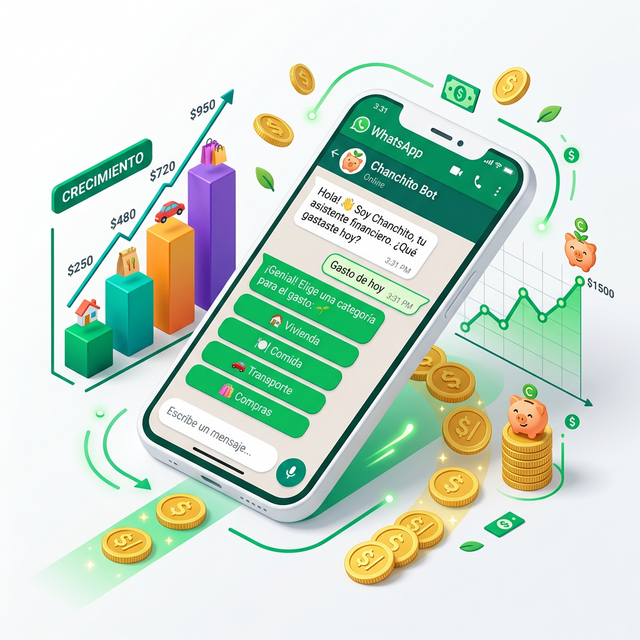
- WhatsApp-based tools like Chanchito let you log expenses by texting like a friend.
- Or a notes app, or a spreadsheet — anything you'll actually use.
At the end of 30 days, sort everything into three buckets: needs, wants, and savings/debt. Most people are shocked by their "wants" total.
Step 2: Build a $500–$1,000 starter emergency fund
Before paying off debt aggressively, save a small buffer. Why? Because the next car repair or medical bill will otherwise force you back onto credit cards.
- Target: $1,000 (or $500 if income is tight).
- Where: a separate high-yield savings account, ideally at a different bank than your checking.
- Speed: aim for 60 days. Sell things, take a short side gig, redirect the "wants" you didn't realize you had.
Step 3: Attack high-interest debt
After the starter fund, pay down anything over 8% interest aggressively. Two methods:
- Avalanche (mathematically optimal): pay minimums everywhere, throw extra money at the highest-rate debt first.
- Snowball (psychologically optimal): pay minimums everywhere, throw extra at the smallest balance first for fast wins.
!TIP If you have credit-card debt above 20% APR, a 0% balance transfer card for 12–18 months can save hundreds of dollars in interest — provided you actually pay it off in that window.
Step 4: Automate a savings transfer on payday
Willpower is a finite resource. Don't rely on it.
- The day you get paid, automatically transfer 10–20% to savings.
- Treat that account as if it doesn't exist for daily spending.
- When you get a raise, send 50% of the raise to that automated transfer before lifestyle creep kicks in.
This is sometimes called "paying yourself first" — the single highest-impact financial habit you can build.
Step 5: Close the gap (income or expenses)
If you've done steps 1–4 and the math still doesn't work, the gap is structural. You have two levers:
Cut recurring costs
Audit subscriptions, insurance, and bank fees once per quarter. The average household has $200+/month in subscriptions, half of which they don't use.
Raise income
- Negotiate your current salary. The average raise from negotiating is 7–10%.
- Take on freelance work in your existing skill set — even 4 hours a week at $40/hour is $640/month.
- Build a slow-income asset: course, content, small product.
Raising income usually moves the needle faster than cutting expenses past a certain point.
A 6-month roadmap
| Month | Focus | Goal |
|---|---|---|
| 1 | Track every expense | Full visibility |
| 2 | Build starter emergency fund | $1,000 saved |
| 3 | Attack highest-interest debt | First debt paid |
| 4 | Automate 10–20% savings | Auto-transfer live |
| 5 | Cut recurring waste | Saving $100+/mo |
| 6 | Raise income or reduce big bill | Permanent gap closed |
FAQ
How much money should I save first, before paying off debt?
Most personal finance experts agree on a $500–$1,000 starter emergency fund before aggressively paying off debt. This buffer prevents new debt when surprises hit. After all high-interest debt is gone, grow the emergency fund to 3–6 months of expenses.
What is the 50/30/20 rule and does it help?
The 50/30/20 rule splits your after-tax income into 50% needs, 30% wants, 20% savings. It's a great starting framework if you're new to budgeting.
Should I invest while paying off debt?
If your debt's interest rate is higher than the expected return on investments (roughly 7% historically), pay off debt first. If you have low-rate debt (like a 3% mortgage), it usually makes sense to invest in parallel and capture any employer 401(k) match.
How long does it take to stop living paycheck to paycheck?
With consistent effort, most people see meaningful progress in 3–6 months and are fully out of the cycle in 12–24 months. Speed depends on the income-to-expense gap and your debt load.
What if I have no extra money to save?
Then step 1 is non-negotiable: track for 30 days. Nine times out of ten the gap appears once you can see where the money goes. The remaining cases need to lift income (negotiation, side work) rather than cut more.
The bottom line
Breaking the cycle isn't a single heroic act — it's five small habits that compound. Start with visibility today. Track your first expense on WhatsApp with Chanchito (free) →
Related reading:
Transform your finances in 30 days
Let Chanchito’s AI do the heavy lifting. Track your expenses on WhatsApp and take back control of your money today.
Start using Chanchito